AI & Automation
AI Framework for Business: Stop Feeling Behind
Learn the 3-layer AI system framework to organize your business processes. Master information, operator, and human layers to implement AI effectively without overwhelm.
Daniel Canosa ·
TL;DR: The key to using AI in business without feeling overwhelmed is a 3-layer framework: (1) centralize your information in one place, (2) use AI operators like Notion AI and Claude Code to handle recurring work, and (3) keep humans focused on judgment calls and relationships. Start with your information layer, then build up from there.
Key Takeaways
- Every business now operates across three layers: an Information Layer (your centralized data), an Operator Layer (AI tools doing the work), and a Human Layer (your judgment and relationships).
- The single most important first step is centralizing your business information in one place, whether that is Notion, Asana, or even a well-structured Google Sheet.
- A simple decision framework keeps tool choices sane: use Notion AI for one-off tasks, custom agents for recurring workflows, and Claude Code for anything involving external tools.
- The goal is the smallest possible tool stack that covers the most ground. Every new tool must earn its place by supporting an actual business process.
- If you feel behind on AI, you are probably behind on process documentation, not tools. That is a much easier (and more valuable) problem to fix.
A month ago, I was overwhelmed by AI.
I mean, I'm in this industry. I build systems for businesses for a living. And I still felt left behind.
So I want to be honest about that because I think most business owners feel exactly the same way right now, and nobody is admitting it.
Every video I was watching was some version of the same thing: "I automated 99% of my work, I made a million dollars, here's the tool." And I kept watching, kept downloading new apps, kept feeling like I was missing something.
But then I stopped and asked myself a real question: are any of these people actually running these systems in their business, or are they just demoing something they built yesterday?
Honestly, mostly the second one. They need views, clicks, course sales. So of course everything has to be the greatest invention ever.
What actually helped me was going back to basics. For the past five years, my work has been the same: define processes for businesses, then implement systems to run those processes.
Businesses run on processes. We just have better tools now. That is it.
Once I accepted that, the overwhelm basically disappeared. Not because I stopped paying attention, but because I finally had a mental model to filter what actually matters.
That is what this post is about.
The Three Layers Every Business Has Now
The framework I landed on is simple. Every business now operates across three layers, and once you see them, you cannot unsee them.
The first layer is the Information Layer.
This is the foundation. Before any AI can do anything useful, it needs access to your actual business information. Your clients, your projects, your SOPs, your workflows, your finances.
If that information is scattered across Google Drive, your email, a few spreadsheets, and someone's head, no AI tool is going to save you. I mean, garbage in, garbage out. That is not a new concept.
For me, that single source of truth is Notion. Everything lives there.
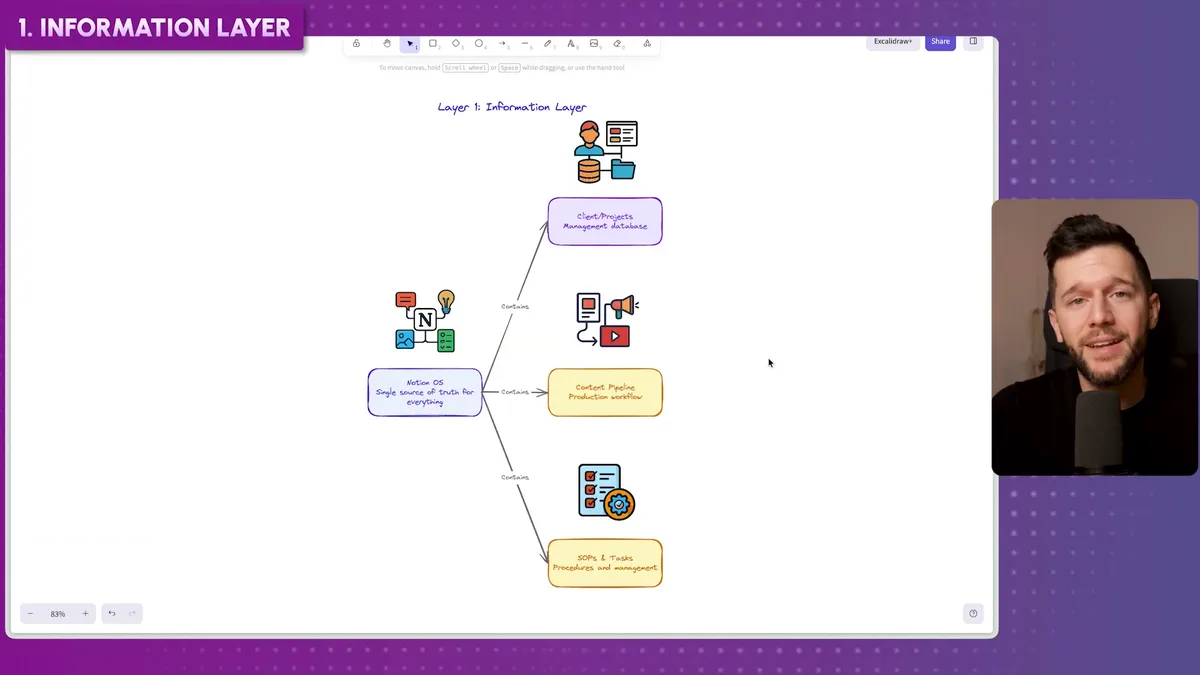
You can see what that looks like in practice above. Clients, projects, content pipeline, production workflow, SOPs, tasks, finances, all of it inside one system. Bear in mind, it does not have to be Notion. Asana works. Even a well-structured Google Sheet is better than nothing. The tool matters less than the discipline of centralizing your information in one place.
This is where AI actually comes in. I have started thinking of AI tools as little hands that can do things humans used to do, because the framing matters. They are not magic. They are not replacing you. They are handling the operational work that does not require your judgment.
This layer has two parts for me right now.
The first part is Notion AI, which splits into two uses. One is the simple conversational interface, where I just prompt it to do something ad hoc. For example, I had a meeting, I tell it to create the notes and extract the actions. It does it. That is something I used to do manually.
The second use is custom agents, which are automated and have full context of my entire information layer. They know my database schemas, my page structures, everything. So they can run recurring processes without me touching them, for example generating a business briefing every week automatically.
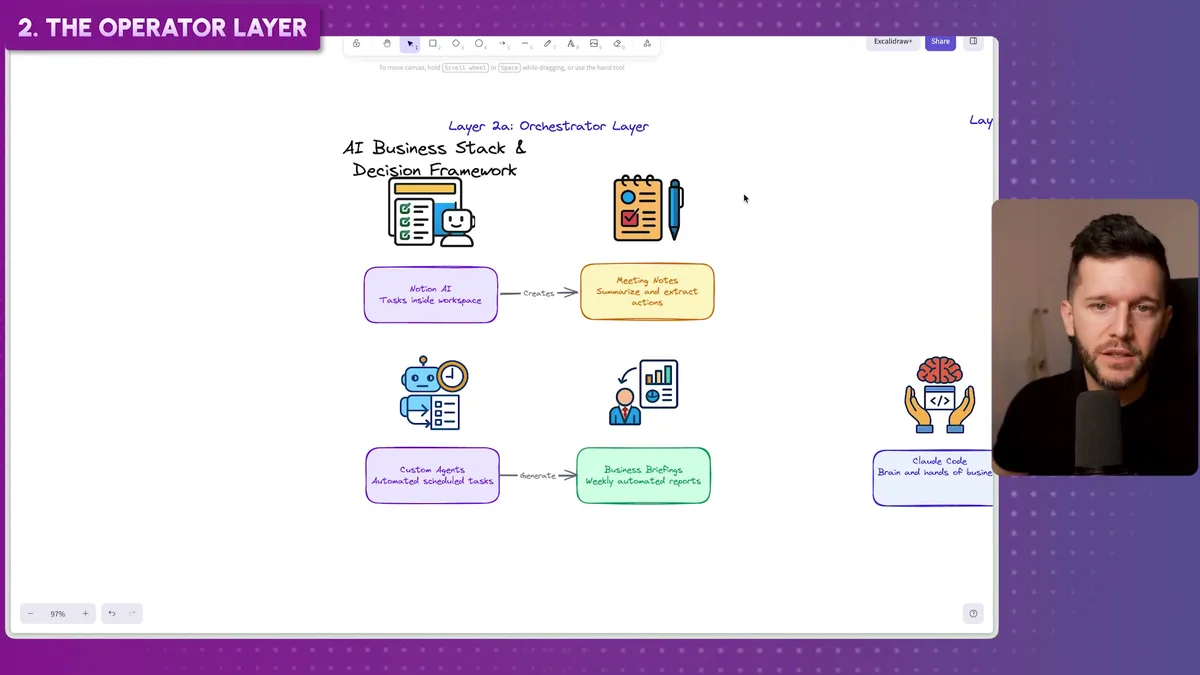
Now, I know the word "code" makes people nervous. It made me nervous too at first. But bear in mind, this tool was built for developers and then basically outgrew that. You do not need to write code to use it.
Claude Code can write scripts, make API calls to your other tools, create dashboards, pull data from external sources. It can do a lot. But without a solid information layer underneath it, it is not that useful.
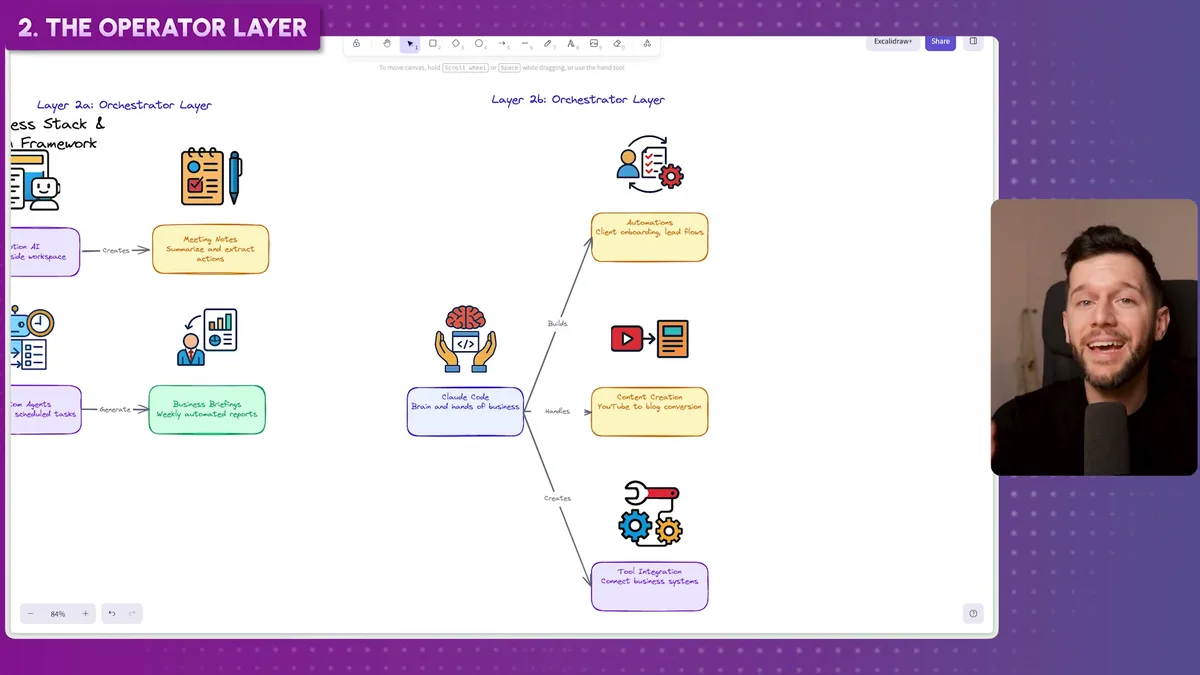
Once you connect Claude Code to your Notion information layer, things get interesting.
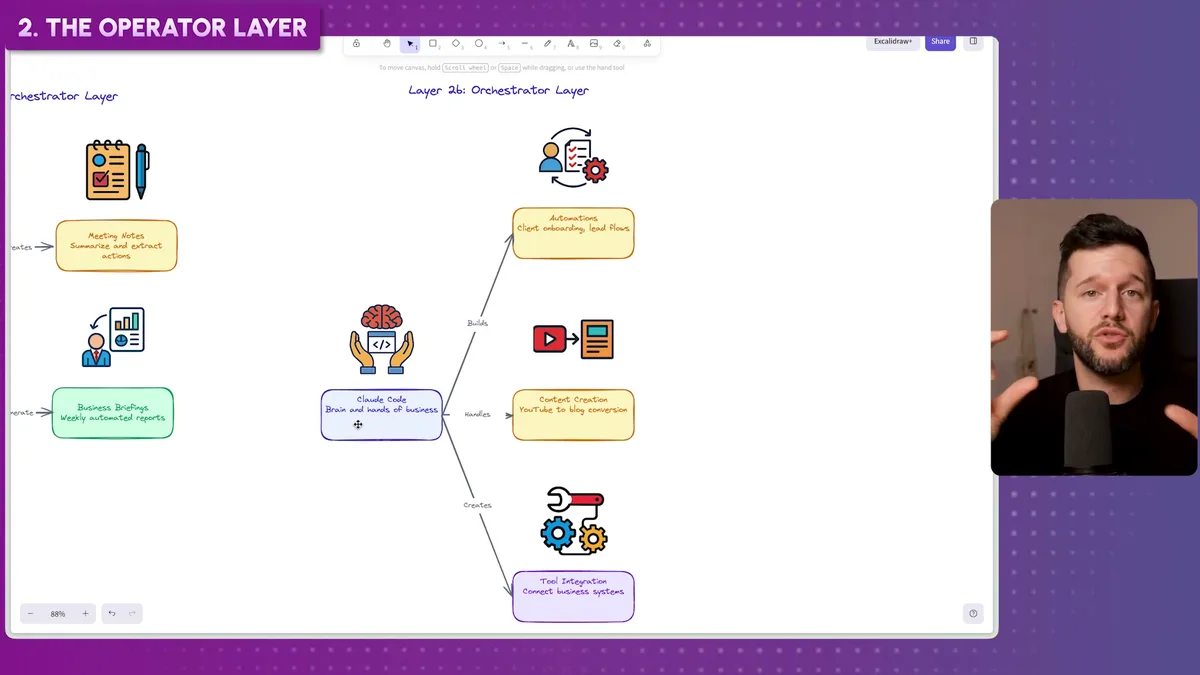
For example, it can build recurring onboarding automations. It can research ideas on the web and create content drafts directly inside Notion. It can pull data from Stripe, your invoicing tool, your client communications, and push everything back to your information layer.
In my opinion, the big unlock is that Claude Code handles all the external connections, and Notion handles everything internal. They complement each other instead of competing.
The third layer is the Human Layer.
This is you. This is talking to clients, getting on calls, making judgment calls, managing the operator layer.
Here is what I actually believe: over time, more and more work is going to fall into the operator layer, and less and less is going to require the human layer. I can already see it happening in my own business. My capacity has increased because Claude Code is handling parts of client fulfillment I used to do myself.
This is not hype. This is just what I am observing.
A Simple Decision Framework That Keeps Me Sane
The three-layer model is the mental model. But day to day, you still need to make decisions. A new tool comes out. A client asks you to automate something. You have a recurring task eating up your time.
How do you decide what to use?
I built a simple decision framework for this, and it comes down to three questions.
Is the task inside Notion, and does it only happen once or occasionally?
Use Notion AI. Just prompt it, it does the thing, done. For example, summarizing a document, extracting action items from a call, drafting a quick response. No setup required, no automation to maintain.
Is the task recurring and does it need a lot of context from your Notion workspace?
Use a Notion custom agent. Let it run automatically. It already knows your data, your schemas, your workflows. For example, weekly business briefings, project status summaries, automatic task creation from a template.
Does it involve external tools or connections outside of Notion?
Use Claude Code. For example, pulling invoice data from Stripe, syncing a CRM, generating content from web research, building a client onboarding flow that touches multiple platforms.
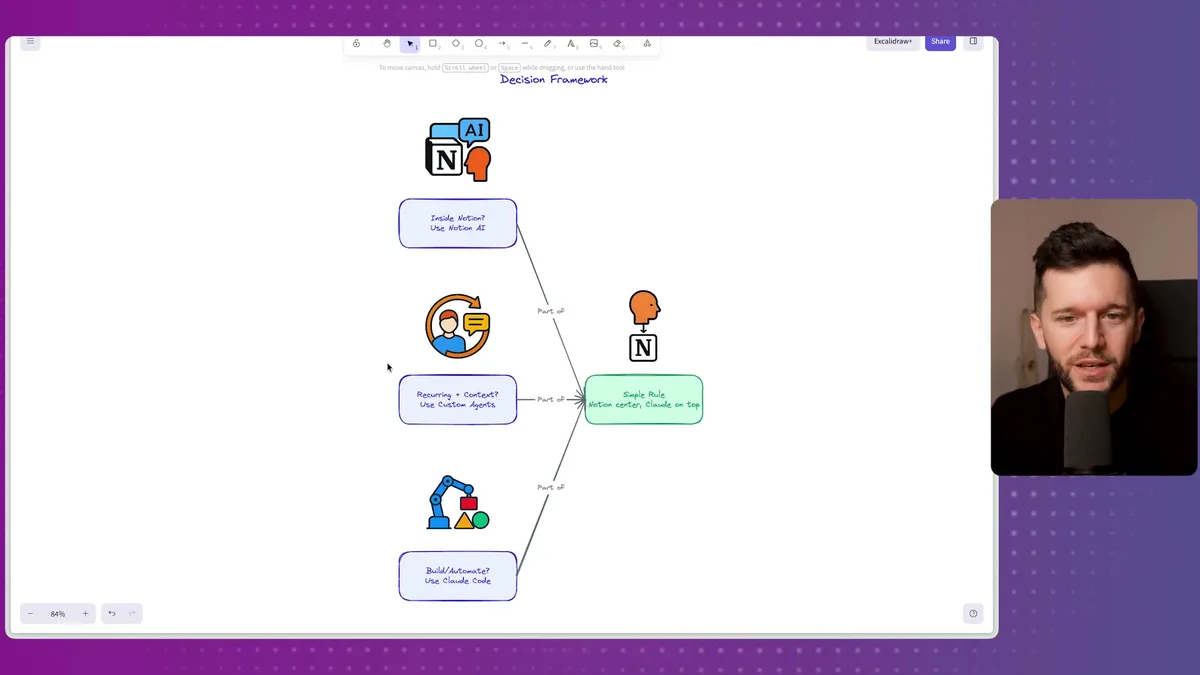
What this gives you is the smallest possible tool stack that covers the most possible ground.
Notion at the center. Claude Code handling the external layer. You managing both.
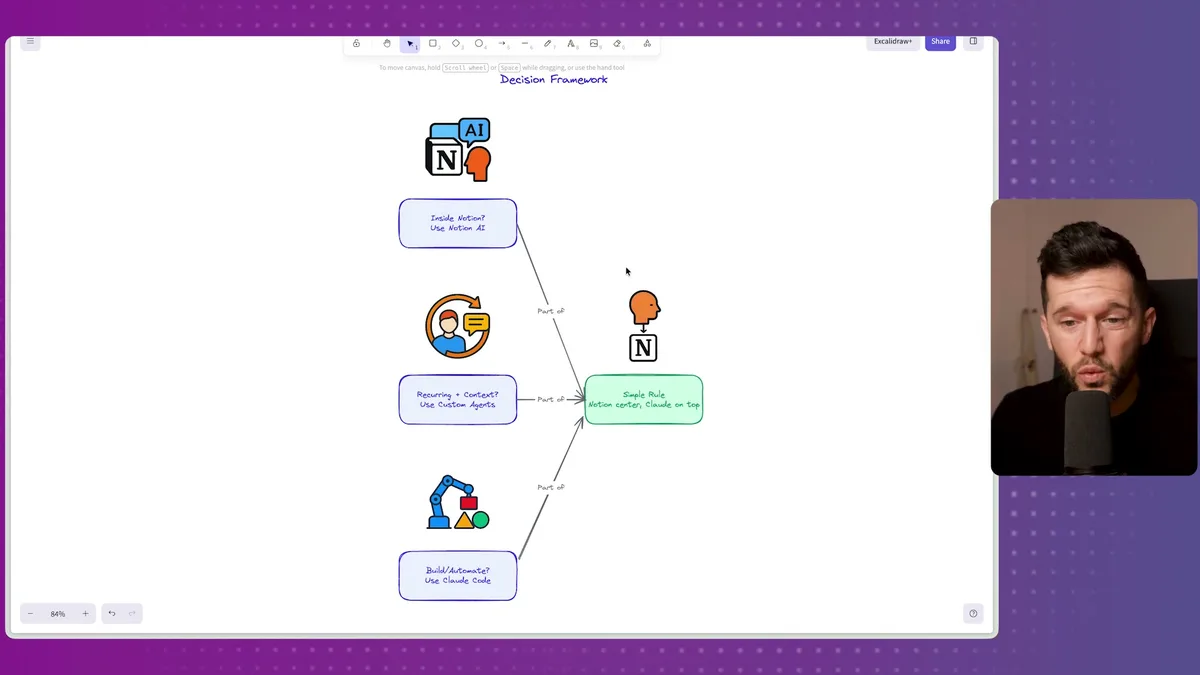
The goal is not to use every tool. The goal is to use the fewest tools that let you run your actual processes.
Because the cost of adding a new tool to your stack is real. There is the time to learn it, the time to connect it, the ongoing maintenance, the subscriptions, the cognitive load of remembering where everything is. Every new tool has to earn its place.
I will not let any new AI release into my world just because someone is hyping it on YouTube. My filter is simple: does this help one of my actual business processes?
And honestly, most of the time the answer is no.
Where to Start if You Are Still Overwhelmed
If everything I just described sounds like a lot, let me simplify it.
Start with the information layer.
That is the only thing that actually has to happen first. Get your information organized in one place. Notion, Asana, Google Sheets, it does not matter. Just make it one place.
Because without that foundation, nothing else works well. Claude Code cannot help you if it does not know anything about your business. Notion AI cannot give you useful context if your data is scattered. Custom agents cannot automate your processes if your processes are not written down anywhere.
The information layer is not exciting. It is not going to get views on YouTube. But it is the difference between AI tools that actually work and AI tools that just look cool in demos.
Once that is in place, think about your processes.
Businesses are basically simple. You have lead generation, sales, fulfillment, after-sales, and finance and admin. That is the whole thing.
Pick the most pressing process, the one that is eating the most of your time or causing the most mistakes. Build the operator layer around that one process first. Get it working. Then move to the next one.
Bear in mind, this is not all smooth sailing. Building these systems takes time upfront. The first few automations will break and you will fix them. But once they are running, they compound. Your capacity grows without your hours growing.
I have seen this with my own clients across different service businesses. The ones who built the information layer first, then layered the operator layer on top, are the ones who are actually getting the capacity gains people keep promising on YouTube.
The ones who skipped the foundation and just started downloading AI tools are still overwhelmed.
So if you feel behind right now, you are probably not behind on tools. You are behind on process documentation. That is a much easier problem to fix, and in my opinion, a much more valuable one.
Frequently Asked Questions
What is the 3-layer AI framework for business?
The framework organizes your business into three layers: the Information Layer (your centralized data in tools like Notion), the Operator Layer (AI tools like Notion AI and Claude Code that handle work), and the Human Layer (you, making judgment calls and managing relationships). Each layer builds on the one below it.
Do I need to know how to code to use this framework?
No. Claude Code was originally built for developers but has outgrown that audience. You do not need to write code to use it. The key requirement is having your business information organized in one place so the AI tools have good data to work with.
Where should I start if I feel overwhelmed by AI tools?
Start with the Information Layer. Get all your business data organized into a single system, whether that is Notion, Asana, or Google Sheets. Without that foundation, no AI tool will deliver consistent results. Once your data is centralized, pick your most time-consuming process and build the operator layer around it first.
Ready to see where your business stands with AI and automation? Take our AI Readiness Scorecard to find out.
Get more like this in your inbox
AI implementation insights for service business founders. No fluff.